Created and hosted by Brian Scherschel. A podcast about the appreciation of kaiju and tokusatsu movies and discovering their historical and cultural value
It’s G-Day at Kaijuvision Radio. Surprise! – We’re releasing the first two episodes of the show this week instead of just one. In our first episode, we discuss our philosophy of the podcast moving forward.
MP3:
Opening Remarks: 0:00 – 2:33
Our Bios: 2:33 – 5:05
How We Became Godzilla Fans: 5:05 – 9:08
Some of our Favorite Non-Godzilla Films: 9:08 – 11:45
Our Impressions of the Godzilla Series 11:45 – 17:11
Our Thoughts on the Kaiju Genre: 17:11 – 21:11
Why the Godzilla Movies are Better than their Reputations 21:11 – 29:07
What We Think of Dubbing: 29:07 – 33:57
Refuting the “And then they got silly” argument: 33:57 – 38:13
The Role of Nostalgia in the Godzilla Movies: 38:13 – 43:51
The Versatility of Godzilla: 43:51 – 45:06
The Japanese National Spirit: 45:06 – 49:01
Closing: 49:01 – End
Host: Brian Scherschel
Co-Host: Nathan Marchand
Editor: Brian Scherschel
Video Location: Japanese Friendship Garden, Fort Wayne Museum of Art, Fort Wayne, Indiana
Hi, this is Brian Scherschel. I co-host Kaijuvision Radio with Nathan Marchand. We only have one week remaining until the release of our first episode next Wednesday, so as the final preparation for beginning our show, I will tell you why it’s the perfect time to create a Godzilla podcast.
I have a Masters Degree in Public Administration and I studied International Affairs and Comparative Politics. Many of the Godzilla movies express the Japanese national spirit in one way or another, whether on economic, social, or political subjects, and discussing these films is an incredibly interesting way to look at Japan. In my opinion, it’s too easy to discuss Godzilla without discussing Japan.
The world is drastically changing and a lot of us wonder what’s going to happen. The nation-state system is undergoing a partial collapse. The creative destruction of capitalism is uncontrollable. The progression of technology and artificial intelligence is reforming the world in ways previously thought impossible. The advancement of genetics will assuredly change the course of history. The world as we know it is collapsing and rebuilding itself, and there is constant death and rebirth.
The post-World War II and post-Cold War order is disintegrating, and the United States is losing its position not only as the dominant military power in the world but also as the leader of the world economic order. As the United States gives up its quasi-imperial role, we will enter a new, likely unstable, multi-polar era. This means that much of the world will go through a re-balance of power, and East Asia will likely be the epicenter of that re-balance.
Advanced industrial societies face many challenges, but in Japan, they are much more intense. Japan has a high debt to GDP ratio, which in 2016 was 250%, which is by far the highest in the world. The economy is stagnant, inflation is very low, and there are 148 jobs for every 100 applicants, which means many jobs are left unfilled. Japan has the most rapidly aging population in the world. Their total population could decline by about 26 million before it stabilizes to around 100 million. That’s slightly over 20% of Japan’s population predicted to disappear. Japan’s high government spending on the elderly and the pension system is a major contributor to the debt. Japan’s young people are up against the harsh reality of bearing the burdens of living in a gerontocracy. They face declining wages and higher taxes, which has caused them to delay getting married and having children, which makes the demographic crisis worse.
Aside from economic and demographic issues, Japan finds itself in an increasingly unstable and unfriendly East Asia. North Korea is a major destabilizing force in the region because of its nuclear program, missile tests, and kidnapping of Japanese citizens over the years. Japan is as far from North Korea as San Francisco is from Seattle. China has taken aggressive steps in the region, specifically its contested claim of ownership of the Senkaku Islands, which are currently administrated by Japan. The number of air defense incidents between Japan and foreign aircraft has rapidly increased in recent years. China has also established the nine-dash line which is the demarcation line of its claim to nearly all of the South China Sea as its exclusive national territory, including the Paracel Islands and the Spratly Islands. China has ignored a 2016 decision by a UN-constituted arbitral tribunal which declared their claim invalid. China has recently established bases on multiple islands in the Spratlys with surface-to-air missiles, long runways, and fortifications. The rise of China is one of the biggest forces of change in the world at this time.
There are many pressures on Japan to increase its military power. These include the pressure of the perceived threat of China, the pressure exerted by the United States to be a more equal partner in the US-Japan alliance because of its own debt and the shrinking of its quasi-empire, and the pressure of Prime Minister Abe’s party to strengthen the Japanese military. However, some Japanese citizens are weary of war and want the government to concentrate on the economy instead of constitutional revisions. In addition, some Japanese, particularly Okinawans, want US forces to leave but Japan, but at the same time, Japan remains almost entirely dependent on the US for defense.
What I find even more interesting is that Japan has built up a huge amount of “soft power”. This relates to the “Cool Japan” phenomenon or what’s called Japan’s “Gross National Cool”. Another nickname for Japan is the “Pokemon Hegemon”. Japan is a cultural superpower, which has an effect on how the rest of the world views them. This helps Japan’s economy, increases tourism and other foreign interest, and increases Japan’s influence around the world. So, here’s my big question: Will Japan ever be able to convert this soft power into real power, if necessary? Down the road, if a crisis in Japan occurs, what will all of this soft power get them? I think at some point we may find out.
Godzilla is an official citizen of Japan, and he is the cultural ambassador for the Shinjuku Ward of Tokyo. He is one of the most visible icons of Japan, right up with Mario, Pikachu, Ultraman, Evangelion, Totoro, Lupin, Naruto, Sonic, Titan, Mega Man, and the Chocobos of Final Fantasy. Godzilla came before all of the others, and in my opinion he’s the genesis of Cool Japan, and therefore, the core of the soft power that Japan projects and exports.
The Godzilla series of films cover many Japanese issues either directly or indirectly. It’s great that these movies are not just one dimensional. Though they may appear simple, they’re often refreshingly intelligent and thought-provoking, allowing us to appreciate them on an entirely different level, which adds to the fun of being a Godzilla fan. These movies are unique, intelligent, and enjoyable all at the same time. As Japan (and the rest of the world) move forward into an uncertain and very challenging future, the Godzilla movies tell us so much about where Japan was in the past and where Japan is today.
Next Wednesday, September 20th at noon Eastern, Nate and I will release the first episode of Kaijuvision Radio. Join us as we appreciate these truly special movies in every way that we can.
Two weeks to go until Episode 1 premieres. In this short video, Brian introduces our YouTube channel featuring scenic videos. The feature of every video will be either nature, like this one, or architecture. The vast majority of the videos are recorded in northeast Indiana, where Kaijuvision Radio is produced.
Host: Brian Scherschel
Editor: Brian Scherschel
Video Location: Eagle Marsh, Allen County, Indiana
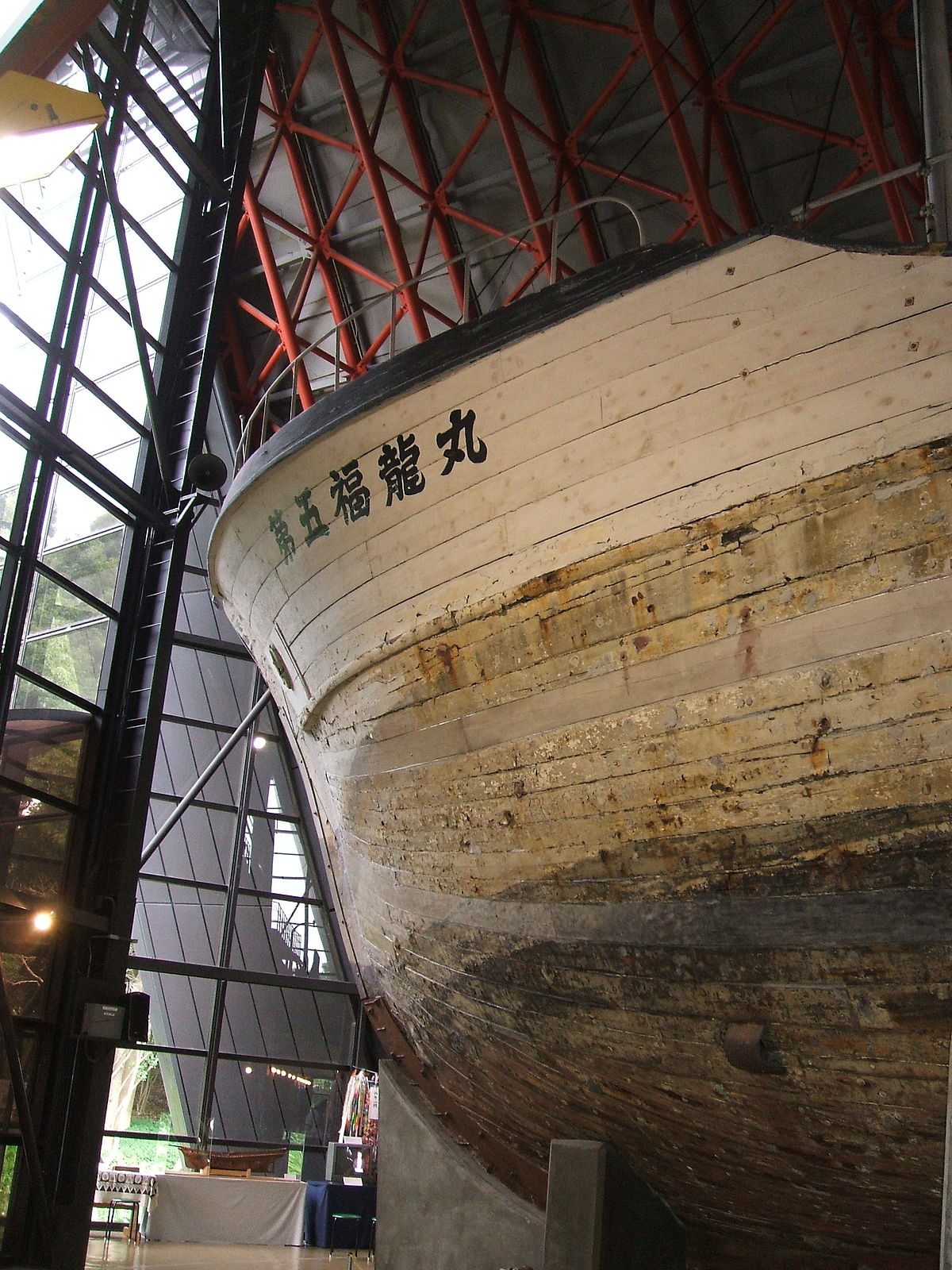
The Lucky Dragon No. 5 today. (Image courtesy of Wikipedia).
Every Godzilla fan knows the story of the Lucky Dragon No. 5 (Daigo Fukuryu Maru). It was a fishing vessel that was exposed to nuclear fallout from the Castle Bravo test. While it was outside the predicted danger zone, the H-bomb detonated by the U.S. on the Bikini Atoll was far more powerful than expected, and on March 1, 1954, the 23-man crew of the ship were contaminated by the radiation. All of them suffered radiation poisoning and one died.
This event was fresh on the minds of the creative team at Toho working on Gojira. It’s why the film opens with a scene of a fishing vessel being destroyed by a blinding flash, which turns out later to have been Godzilla, and why it was implied that Godzilla was awakened and mutated by American H-bomb tests.
The Japanese newspaper Asahi Shimbun was recently granted a rare chance to tour the inside of the now 70-year-old ship, which was decommissioned in 1967 and later moved in 1976 to the Yumenoshima district of Tokyo’s Koto Ward and preserved in a museum in the Daigo Fukuryu Maru Exhibition Hall. They took several photos and 360-degree images of the boat. You can view them here.
To this day, the ship remains a symbol of the anti-nuclear movement in Japan. Along with the bombings of Hiroshima and Nagasaki at the end of World War II, this was one of the most potent and palpable examples of the “nuclear curse” on Japan. It was a demoralizing blow to the Japanese psyche, which was suffering other repercussions from nuclear tests at the time, such as contaminated fish being caught in their waters. It wasn’t until the 3/11 disasters, which included the Fukushima meltdown, that Japan suffered as large a nuclear-related incident. These led to an increase in distrust of nuclear power and the shutdown of many nuclear plants. This is problematic given that Japan is in desperate need of domestic energy sources since, being an island nation, they have to import most of them.
You might think it’s crazy, then, that anyone in Japan would want to preserve a ship that reminds them of this “curse.” I think the Japanese do it for that very reason. It allows them a means to look back on their past and remember their convictions. These events have made indelible marks on their history and culture, and they can’t afford to forget them.
Our first G-Fest has come and gone! We had a great experience. Thankfully, there were two of us so we were able to split up and cover the panels and other events during the three-day show.
First, during the “Mothra Mania” panel on Friday, we were surprised by a great performance by two cosplayers who sang “Mothra’s Song” as the Shobijin, Mothra’s twin fairies.
There were costumes and cosplayers in abundance during the convention.
We attended the costume contests, which featured some really impressive entries.
It was fun to see all of the films at the Pickwick Theatre. Watching the movies with a huge group of fans was different than watching them with a general audience. They would cheer and applaud at key moments like when a kaiju or favorite actor first appeared, or when Godzilla defeated his foe.
The Pickwick Theatre, built in 1928 in Park Ridge, Illinois
The films offered this year were “King Kong vs. Godzilla” (1963 International Version), “Dragon Wars: D-War” (2007), “Godzilla X Megaguirus” (2000), “Godzilla” (2014), “Kong: Skull Island” (2017), and “Shin Godzilla” (2016).
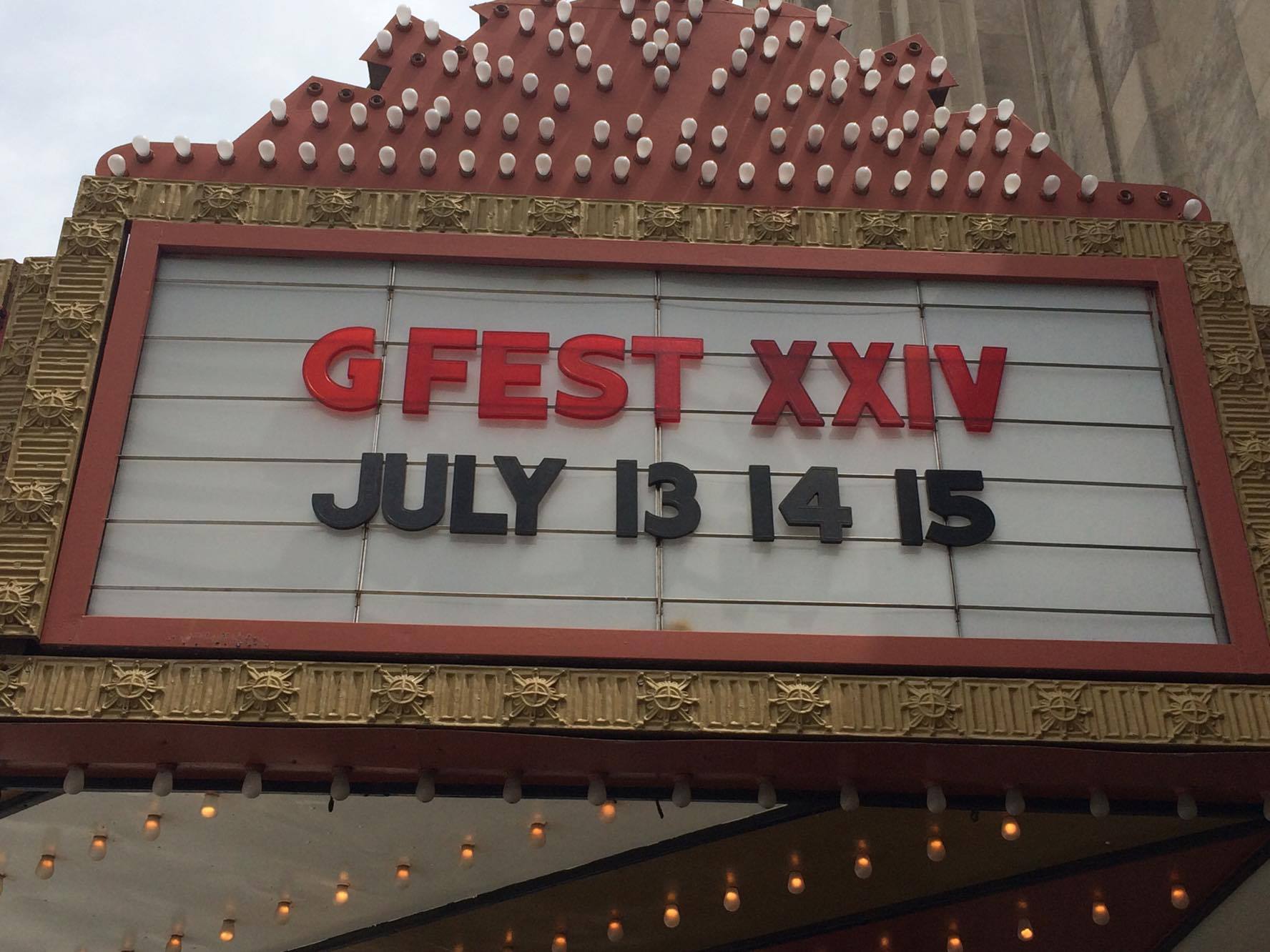
The Pickwick Theatre marquee
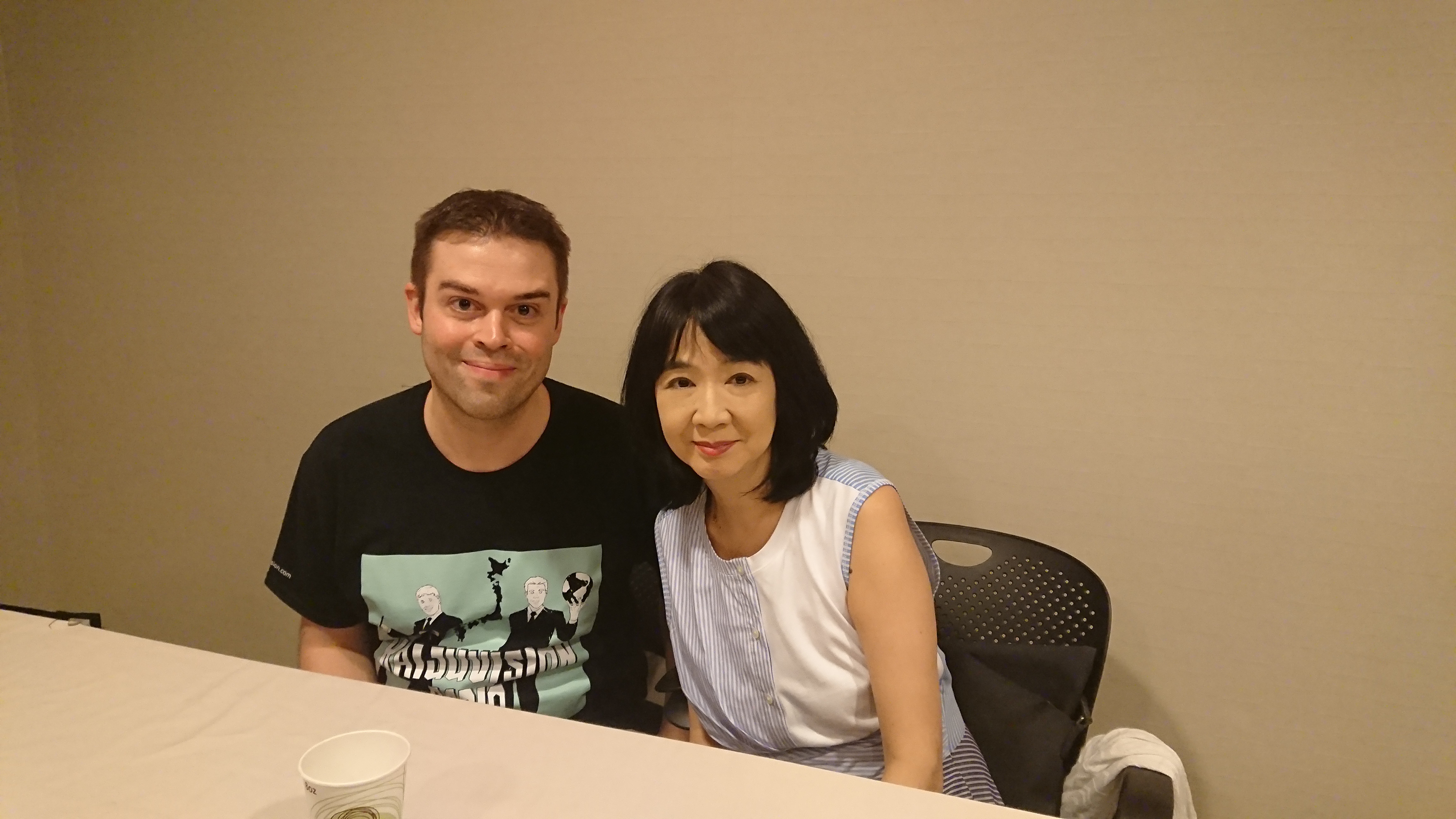
Because I’m a violinist who has great admiration for her work, I opted to meet the very talented composer Michiru Oshima, who wrote the music for “Godzilla X Megaguirus” (2000), “Godzilla Against Mechagodzilla” (2002), and “Godzilla: Tokyo S.O.S.” (2003).
Brian Scherschel (left) Composer Michiru Oshima (right)
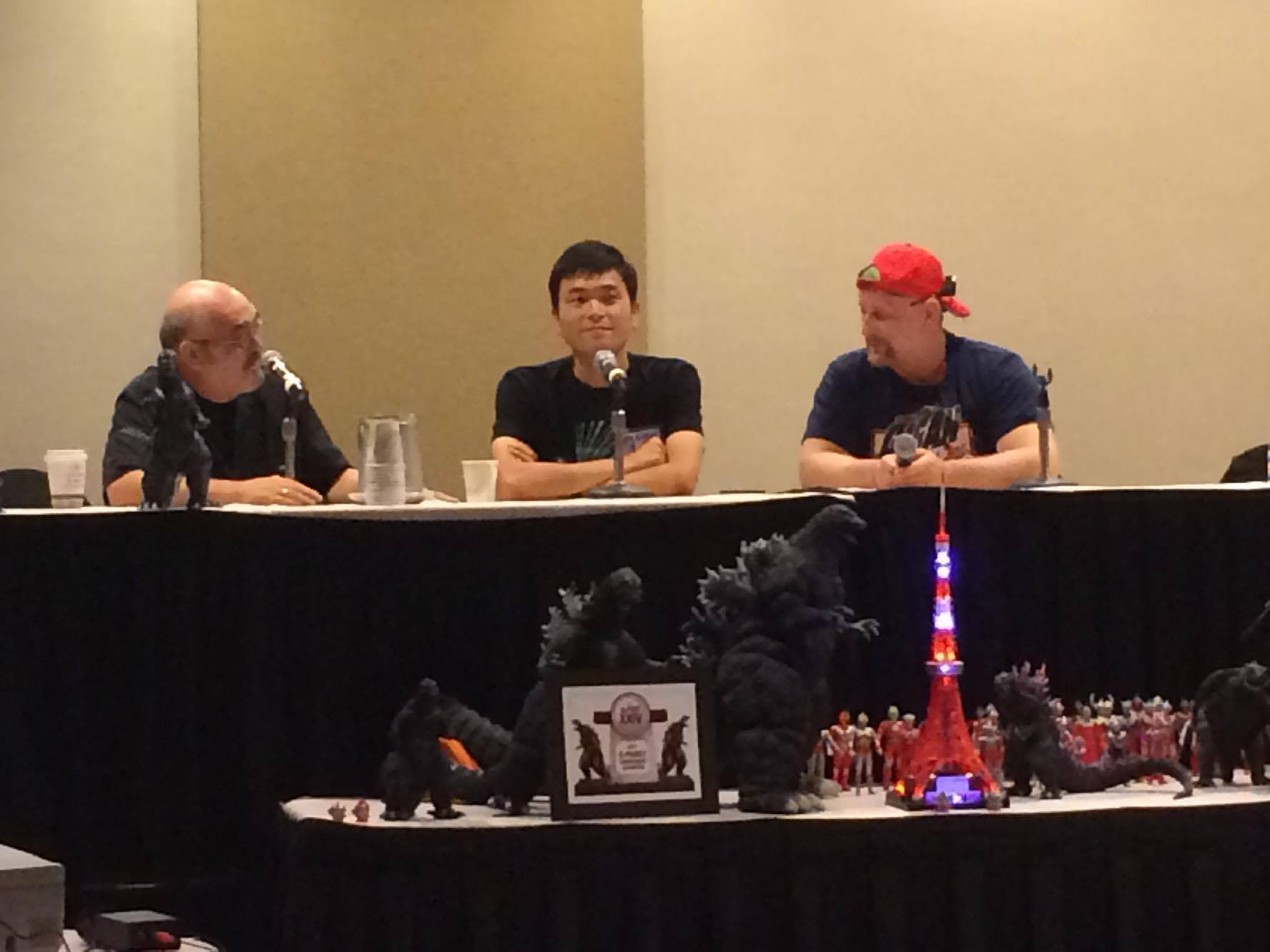
Nathan met headlining G-guest Shinji Higuchi, the co-director and special effects director for “Shin Godzilla” (2016).
Most noteworthy, Nathan was also asked to join “The Art of Kaiju Writing” panel about writing kaiju fiction.
We also both met Robert Scott Field, who played the android M-11 in the film “Godzilla vs. King Ghidorah” (1991). Since he lives in Osaka, he was able to give fans, including myself, information about what’s been happening lately in his adopted country at his “Japan Update” panel.
Here are pictures from some of the G-Guests we saw. It’s awesome that they traveled to the U.S. to visit with us and tell us about their Godzilla experiences.
Archie Waugh (left) Assistant film director Kazuhiro Nakagawa (middle) Actor and translator Robert Scott Field (right)
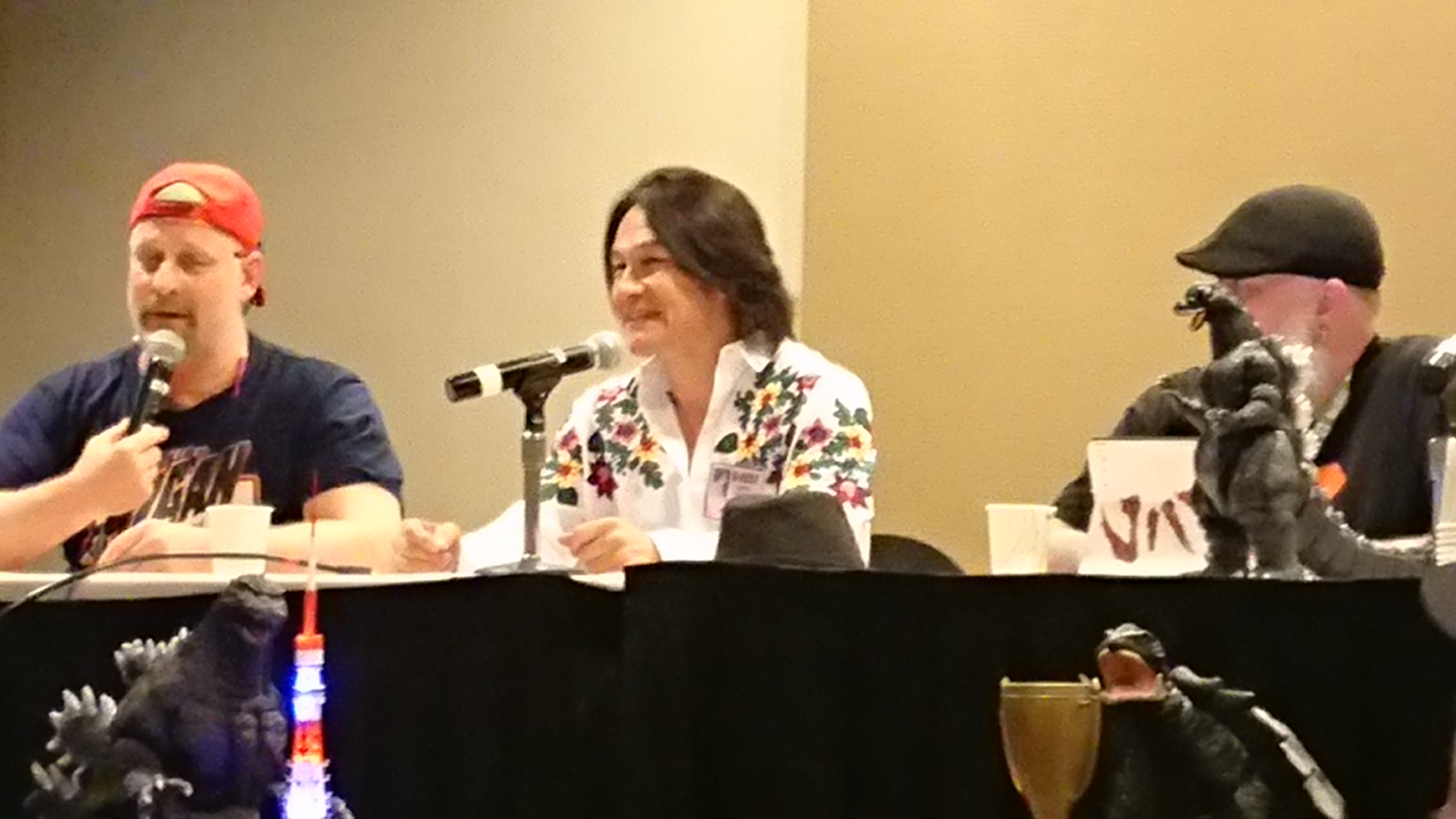
Actor and translator Robert Scott Field (left) Suitmation actor, actor, and stunt performer Ryuki Kitaoka (middle) Host of Kaijucast Kyle Yount (right)
It’s only been a few days since the convention, and Nate misses it already, while I’m getting caught up on rest.
Now my mind is buzzing with ideas about how to continue to make this podcast even better after all we learned and experienced last weekend.