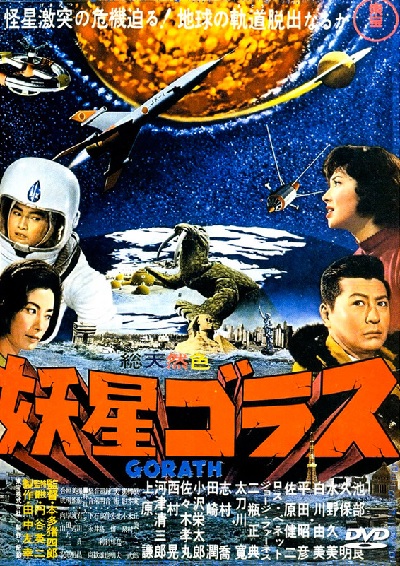
Episode 44: Gorath (1962) (Near Earth Objects/Science of Gorath)

And now it’s time to appreciate the immense imaginative power of Gorath! When it comes to mind-bending Toho technology, rows of atomic-powered thrusters nearly the size of New Mexico in Antarctica is on par with the Dimension Tide black hole gun from Godzilla vs. Megaguirus –and I love both of these inventions! A special effects tour de force, Gorath is everything that a toku fan would want. It even has a kaiju – Maguma! Well, the Japanese version does, at least. The English language version is the very definition of mediocrity. The related topic for this episode is Near-Earth Objects (NEOs),Planetary Defense, and other scientific aspects related to Gorath.

This episode is dedicated to Ryo Ikebe.

I’d like to send a shout-out to our patron Sean Stiff for donating at the Kaiju Visionary level. Thank you for your support! I really appreciate it.

MP3:
Introduction: 0:00 – 1:40

Part 1 – Film Description: 1:40 – 8:28

Part 2 – Opinion and Analysis: 8:28 – 42:10

Part 3 – Related Topic: 42:10 – 58:20

Closing: 58:20 – End


Host/Editor/Director/Scenic Videos: Brian Scherschel

Video Location: Rousseau Centre (left) and First Financial Center at the Anthony Wayne Building (center right), Fort Wayne, Indiana

Video Notes: The Rousseau Centre (completed in 1971) and the Anthony Wayne Building (completed in 1964) are examples of mid to late 1960s architecture.

Music: Audiophiliac (www.fiverr.com/audiophiliac)

“Torii Gate” Banners: Kevin Geary (kevincgearydesign.com)

Logos: Nanoparticles (www.fiverr.com/nanoparticles)

Copyright Brian J. Scherschel

All Rights Reserved
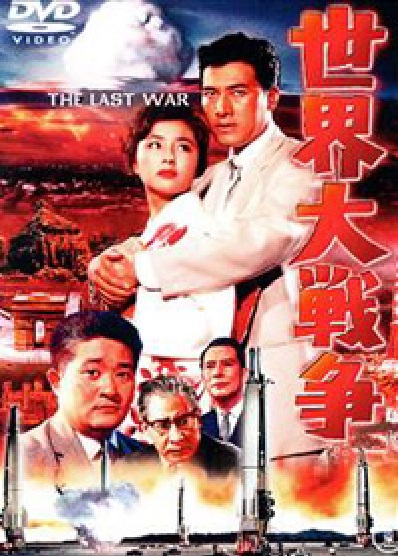
Episode 43: The Last War (1961) (NATO (The North Atlantic Treaty Organization))

Brian and Daniel team up for this rare and incredible tokusatsu disaster film from Toho. Find it and watch it! It’s a nuclear war scenario between stand-ins for NATO and the Warsaw Pact at the height of the Cold War – and Japan is caught in between! It’s like an Ozu film with Tsuburaya’s special effects in it. It’s also a nearly perfect film for this show (besides Shin Godzilla). Includes a talented cast including Akira Takarada, Yuriko Hoshi, Frankie Sakai, and Jerry Ito. The related topic for this episode is NATO (North Atlantic Treaty Organization).

You can find Daniel DiManna’s Godzilla Novelization Project here:

godzillanovelizationproject.wordpress.com

This episode is dedicated to Yuriko Hoshi.

I’d like to send a shout-out to our patron Sean Stiff for donating at the Kaiju Visionary level. Thank you for your support! I really appreciate it.


MP3:

Introduction: 0:00 – 2:01

Part 1 – Film Description: 2:01 – 8:19

Part 2 – Opinion and Analysis: 8:19 – 1:23:25

Part 3 – Related Topic: 1:23:25 – 1:41:36

Closing: 1:41:36 – End


Host/Editor/Director/Scenic Videos: Brian Scherschel

Guest Co-Host: Daniel DiManna

Video Location: Giant American Flag, Fort Wayne, Indiana

Music: Audiophiliac (www.fiverr.com/audiophiliac)

“Torii Gate” Banners: Kevin Geary (kevincgearydesign.com)

Logos: Nanoparticles (www.fiverr.com/nanoparticles)

Copyright Brian J. Scherschel

All Rights Reserved
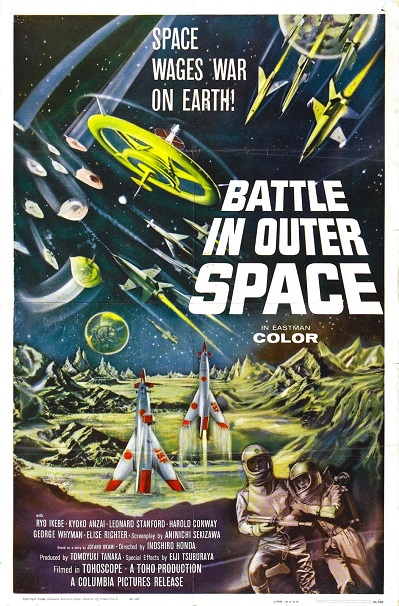
Episode 42: Battle in Outer Space (1959) (The Space Race between the US and the USSR)

Daniel DiManna of the Godzilla Novelization Project comes back to the show to review this tokusatsu extravaganza. The film is based in science-fiction, action, and Ishiro Honda’s particular brand of optimistic pacifism. With the combination of superb models and vehicles, top-notch effects, and a unique fast-paced story, the movie does everything well all at once. We discuss how cool it would be to be inside the theater that gets destroyed by an absolute zero weapon in the movie you’re watching in it, Yoshio Tsuchiya’s mind control adventure, and militarizing the crap out of the space program in the name of peace. The related topic for this episode is the Space Race between the United States and the Soviet Union.

You can find Daniel DiManna’s Godzilla Novelization Project here:

godzillanovelizationproject.wordpress.com

This episode is dedicated to Eiji Tsuburaya.

I’d like to send a shout-out to our patron Sean Stiff for donating at the Kaiju Visionary level. Thank you for your support! I really appreciate it.


MP3:

Introduction: 0:00 – 2:36

Part 1 – Film Description: 2:36 – 7:10

Part 2 – Opinion and Analysis: 7:10 – 1:41:23

Part 3 – Related Topic: 1:41:23 – 1:59:17

Closing: 1:59:17 – End


Host/Editor/Director/Scenic Videos: Brian Scherschel

Guest Co-Host: Daniel DiManna

Video Location: Lincoln Bank Tower, Fort Wayne, Indiana

Music: Audiophiliac (www.fiverr.com/audiophiliac)

“Torii Gate” Banners: Kevin Geary (kevincgearydesign.com)

Logos: Nanoparticles (www.fiverr.com/nanoparticles)

Copyright Brian J. Scherschel

All Rights Reserved
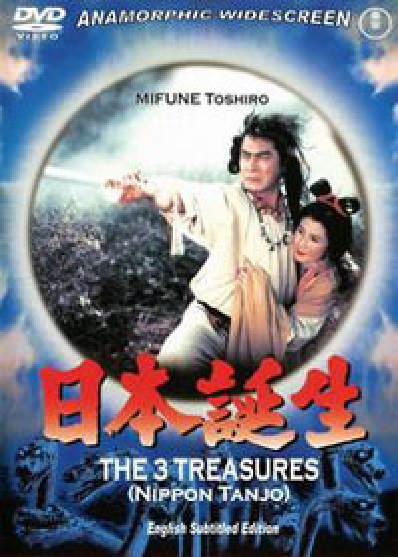
Episode 41: The Three Treasures a.k.a. Nippon tanjo (The Birth of Japan) (1959) (Shinto)

Daniel DiManna of the Godzilla Novelization Project joins me to appreciate Kaijuvision’s first epic.  182 minutes long, it’s the Japanese response to Cecil B. DeMille’s The Ten Commandments (1956).  The kaiju is Yamata no Orochi, the 8-headed dragon.  Toshiro Mifune plays the legendary Prince Yamato Takeru and the mythical god Susanoo.  Since this is a religious epic, the related topic is Shinto.

You can find Daniel DiManna’s Godzilla Novelization Project here:

godzillanovelizationproject.wordpress.com

This episode is dedicated to Toshiro Mifune.

I’d like to send a shout-out to our patron Sean Stiff for donating at the Kaiju Visionary level. Thank you for your support! I really appreciate it.

MP3:

Introduction: 0:00 – 2:35

Part 1 – Film Description: 2:35 – 9:44

Part 2 – Opinion and Analysis: 9:44 – 2:00:28

Part 3 – Related Topic: 2:00:28 – 2:31:23

Closing: 2:31:23 – End


Host/Editor/Director/Scenic Videos: Brian Scherschel

Guest Co-Host: Daniel DiManna

Video Location: Headwaters Park, Fort Wayne, Indiana

Music: Audiophiliac (www.fiverr.com/audiophiliac)

“Torii Gate” Banners: Kevin Geary (kevincgearydesign.com)

Logos: Nanoparticles (www.fiverr.com/nanoparticles)

Copyright Brian J. Scherschel

All Rights Reserved

What’s Going on with “Kunashiroshima” in “Varan, the Unbelivable” (1962)

by Brian Scherschel

Background

I mentioned in episode 40 on “Varan” that the American version of the movie loves the word “Kunashiroshima”, as it is said plenty of times.  The creators of the American version decided to make Kunashiroshima an island.  They moved every event in the movie to this island.  In the Japanese version, the events take place in the mountains of Tohoku in Iwaya Village.  The military and scientists kill Varan at Haneda Airport in Tokyo.

The island of Kunashir is in the Kuril Islands, which are called the Northern Territories in Japan.  The Japanese refer to this island as Kunashiri.  The Soviet Union invaded this group of islands towards the end of the Great Pacific War.  They have been Soviet/Russian territory ever since.

In a previous article, I mentioned how this disputed territory will likely never be resolved because neither side is budging despite what the president of Russia said to Prime Minister Abe recently.  There are currently a significant number of Russian troops on Kunashir and Iturup, because of the recent increases in global tension.  All of these islands are very close to Hokkaido.

The Kuril Islands (source: Google Earth)

Why the Location Change?

Why is the location changed and then given this name in the American version of Varan?  Shima in Japanese translates to “island”.  So the island in the movie is Kunashiro Island.  Sid Harris, the screenwriter for Varan, may have purposely changed the location to Kunashir in order to connect Varan with the Soviet Union.  Varan represents the Soviets, who are lying in wait to attack and invade.  Varan is in the lake and is ready to attack at any time.

The American version was released at the height of the Cold War in 1962.  So this type of symbolism would fit with the times.

Connection to Other Kaiju Films

This isn’t really new though.  In previous movies covered in the show, there have been connections made between Godzilla and the United States because of his relation to nuclear weapons.  Rodan may represent the Soviet Union as well.  King Ghidorah has a possible connection to China in the 1964 Ghidorah film.

While I usually expected Takeshi Kimura or Shinichi Sekizawa to do this, I didn’t expect the American remake of Varan to do it.  Viewers don’t really look for the American remakes to be smart.  It’s not necessarily “in your face” symbolism, just as the other Japanese movies have done.  If the symbolism was obvious, then it wouldn’t be as good.

If this is the case, then bravo to whoever decided to do it, because it works!  It’s even in line with what other Japanese kaiju films have done!