What’s Going on with “Kunashiroshima” in “Varan, the Unbelivable” (1962)

by Brian Scherschel

Background

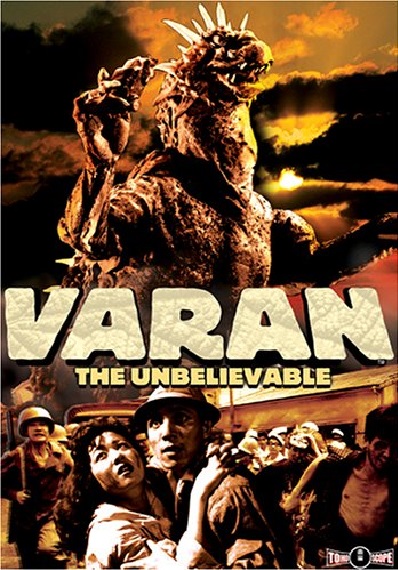
I mentioned in episode 40 on “Varan” that the American version of the movie loves the word “Kunashiroshima”, as it is said plenty of times.  The creators of the American version decided to make Kunashiroshima an island.  They moved every event in the movie to this island.  In the Japanese version, the events take place in the mountains of Tohoku in Iwaya Village.  The military and scientists kill Varan at Haneda Airport in Tokyo.

The island of Kunashir is in the Kuril Islands, which are called the Northern Territories in Japan.  The Japanese refer to this island as Kunashiri.  The Soviet Union invaded this group of islands towards the end of the Great Pacific War.  They have been Soviet/Russian territory ever since.

In a previous article, I mentioned how this disputed territory will likely never be resolved because neither side is budging despite what the president of Russia said to Prime Minister Abe recently.  There are currently a significant number of Russian troops on Kunashir and Iturup, because of the recent increases in global tension.  All of these islands are very close to Hokkaido.

The Kuril Islands (source: Google Earth)

Why the Location Change?

Why is the location changed and then given this name in the American version of Varan?  Shima in Japanese translates to “island”.  So the island in the movie is Kunashiro Island.  Sid Harris, the screenwriter for Varan, may have purposely changed the location to Kunashir in order to connect Varan with the Soviet Union.  Varan represents the Soviets, who are lying in wait to attack and invade.  Varan is in the lake and is ready to attack at any time.

The American version was released at the height of the Cold War in 1962.  So this type of symbolism would fit with the times.

Connection to Other Kaiju Films

This isn’t really new though.  In previous movies covered in the show, there have been connections made between Godzilla and the United States because of his relation to nuclear weapons.  Rodan may represent the Soviet Union as well.  King Ghidorah has a possible connection to China in the 1964 Ghidorah film.

While I usually expected Takeshi Kimura or Shinichi Sekizawa to do this, I didn’t expect the American remake of Varan to do it.  Viewers don’t really look for the American remakes to be smart.  It’s not necessarily “in your face” symbolism, just as the other Japanese movies have done.  If the symbolism was obvious, then it wouldn’t be as good.

If this is the case, then bravo to whoever decided to do it, because it works!  It’s even in line with what other Japanese kaiju films have done!
Episode 40: Varan (1958) (Hisabetsu-Buraku) (Discriminated Communities)

Kaiju non-fiction author John LeMay joins me for a detailed analysis on the good Japanese version of Varan, and a brief review of the pain-inducing American version “Varan, the Unbelievable” starring Myron Healey from “The Unearthly” and released in theaters by the same company that gave us “The Skydivers” and “Beast of Yucca Flats”. John tells us all about the complicated story behind the making of Varan, because it was originally meant for television. We talk about Varan and his design and complicated origin. I notice the many similarities between Yuriko from this movie and Yuri from GMK (2001). The related topic for this episode is the hisabetsu-buraku (discriminated communities), who may be represented as the natives in the movie.

You can find all of John LeMay’s books on Amazon here: http://www.amazon.com/John-LeMay/e/B003KTW83K/ref=sr_ntt_srch_lnk_2?qid=1539779359&sr=8-2.

This episode is dedicated to master prop and monster suit builder Keizo Murase.

I’d like to send a shout-out to our patron Sean Stiff for donating at the Kaiju Visionary level. Thank you for your support! I really appreciate it.

MP3:

Introduction: 0:00 – 2:02

Part 1 – Film Description: 2:02 – 8:01

Part 2 – Opinion and Analysis: 8:01 – 54:51

Part 3 – Related Topic: 54:51 – 1:05:48

Closing: 1:05:48 – End


Host/Editor/Director/Scenic Videos: Brian Scherschel

Guest Co-Host: John LeMay

Video Location: Fox Island County Park (Bowman Lake), Allen County, Indiana

Music: Audiophiliac (www.fiverr.com/audiophiliac)

“Torii Gate” Banners: Kevin Geary (kevincgearydesign.com)

Logos: Nanoparticles (www.fiverr.com/nanoparticles)

Copyright Brian J. Scherschel

All Rights Reserved

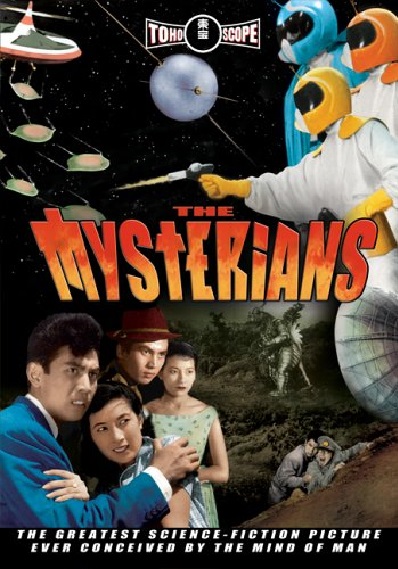
Episode 39: The Mysterians (1957) (Normalization of Japan-USSR Relations)

They want your land, your women, then more of your land, and, well, you get the idea. The aliens have even searched through binders full of women for very best ones. Listen as I analyze Moguera, the Markalite FAHPs, and those fabulous matte paintings! And then I’ll connect the story in the movie to contemporary events: The normalization of diplomatic relations between Japan and the Soviet Union in 1956.

This episode is dedicated to eminent virtuoso actor Takashi Shimura.

I’d like to send a shout-out to our patron Sean Stiff for donating at the Kaiju Visionary level. Thank you for your support! I really appreciate it.

MP3:

Introduction: 0:00 – 2:35

Part 1 – Film Description: 2:35 – 10:04

Part 2 – Opinion and Analysis: 10:04 – 33:19

Part 3 – Related Topic: 33:19 – 45:39

Closing: 45:39 – End


Host/Editor/Director/Scenic Videos: Brian Scherschel

Video Location: Hampton Inn & Suites by Hilton construction site, Fort Wayne, Indiana

Music: Audiophiliac (www.fiverr.com/audiophiliac)

“Torii Gate” Banners: Kevin Geary (kevincgearydesign.com)

Logos: Nanoparticles (www.fiverr.com/nanoparticles)

Copyright Brian J. Scherschel

All Rights Reserved

Episode 38: Half Human (1955) (Genetic Origin of the Ainu People)

Season 2 at Kaijuvision Radio begins with the first non-Godzilla kaiju film from Toho Studios.  This Japanese take on the Abominable Snowman phenomenon is a story about the dark side of humanity.  The Japanese cut of the movie is effectively banned in Japan because of its depiction of the Ainu people as savages.  I find interesting parallels between this film and Disney’s “Song of the South” (1946), as well as “Boggy Creek II: And the Legend Continues” (1984), which was made famous by Mystery Science Theater 3000.  The related topic is The Genetic Origin of the Ainu People.

This episode is dedicated to the great Ishiro Honda.

I’d like to send a shout-out to our patron Sean Stiff for donating at the Kaiju Visionary level.  Thank you for your support!  I really appreciate it.

MP3:

Introduction: 0:00 – 4:27

Part 1 – Film Description: 4:27 – 11:08

Part 2 – Opinion and Analysis: 11:08 – 28:57

Part 3 – Related Topic: 28:57 – 40:18

Closing: 40:18 – End


Host/Editor/Director/Scenic Videos: Brian Scherschel

Video Location: American Electric Power Building, Fort Wayne, Indiana

Video Notes: The clouds in this video are part of the west edge of the remnants of Hurricane Florence, taken on September 17, 2018 in Fort Wayne.  We wish a speedy recovery to everyone effected by this disastrous hurricane.

Music: Audiophiliac (www.fiverr.com/audiophiliac)

“Torii Gate” Banners: Kevin Geary (kevincgearydesign.com)

Logos: Nanoparticles (www.fiverr.com/nanoparticles)

Copyright Brian J. Scherschel

All Rights Reserved

The Greatness of Toho Classic Sci-Fi

by Brian Scherschel

On September 19th, Kaijuvision Radio will begin its 2nd season.

Now that the Godzilla journey is over, it’s time to visit the kaiju we didn’t get to last season.  In this new chronological journey, I’ll be tackling many of the classic Toho sci-fi movies that don’t have Godzilla in them.  That includes non-Godzilla kaiju movies as well as non-kaiju tokusatsu movies.  The time period is 1955-1977: 22 years of fun, fantastic, and underrated Toho classics.  There will be episodes for the new Godzilla movies as they come out too.

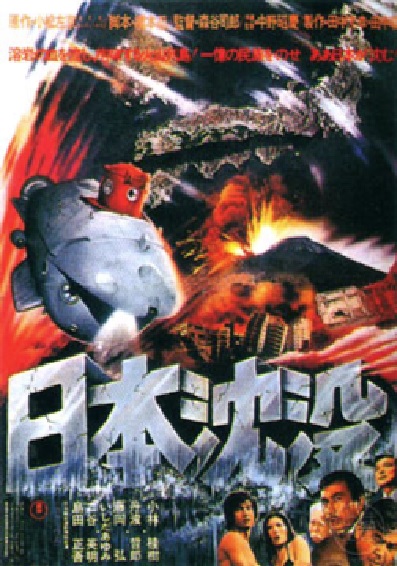
The Submersion of Japan (1973)

Kaijuvision is sticking with the creative community that brought us the Showa Godzilla movies, including Ishiro Honda, Tomoyuki Tanaka, Shinichi Sekizawa, Akira Ikufube, Masaru Sato, and Teruyoshi Nakano.  Of course we get to see many of Toho’s contract actors like Akira Takarada, Kumi Mizuno, Akihiko Hirata, and Takashi Shimura.  We even get to see Toshiro Mifune in this season!  Haruo Nakajima often played the kaiju depicted in these movies.

I love the concepts and ideas that these movies present to the viewers.  These movies are intriguing and fascinating.  They make you want to watch them again and again.  Almost all of them are in wonderful color, and many are filmed in Tohoscope.  Additionally many of Toho’s best actors were in these films.  In contrast, American sci-fi movies were often relegated to black and white film, and good actors often avoided them.

These films are not only interesting, but they’re also culturally relevant.  They tap into the Japanese cultural zeitgeist like many of the best Godzilla movies do.  Since Kaijuvision excels in examining these kinds of connections, they make perfect sense to analyze.

What’s great is that these movies are more available and more affordable than they ever have been before.  Many of them used to be “rare DVDs”.  The DVD guide for these movies came out last week, so check out where to buy them.  As current listeners know, Kaijuvision Radio prefers the Japanese versions with English subtitles.  It’s much closer to the real thing than these sometimes horrific English dubs.

So strap yourselves in for another season of movie greatness!

Here again is the list:

Half Human (1955), The Mysterians (1957), Varan (1958), The Three Treasures (1959), Battle in Outer Space (1959), The Last War (1961), Gorath (1962), Matango (1963), Atragon (1963), Dogora, the Space Monster (1964), Frankenstein Conquers the World (1965), War of the Gargantuas (1966), Latitude Zero (1969), Space Amoeba (1970), The Submersion of Japan (1973).